A rash guard lives or dies on its fabric. The print is what sells it on a screen, but the blend, the weight, and the seams are what decide whether it stretches with an athlete, survives a season of chlorine or mat friction, and takes an all-over graphic cleanly. Two rash guards can look identical in a product photo and behave nothing alike on a body. If you are ordering in bulk, the fabric spec is where your money is actually going, so it is worth understanding what the numbers mean before you approve a sample. This is a look under the jersey at the material decisions that matter.
The blend sets the personality
Almost every rash guard is a synthetic knit blended with an elastic fiber, and the two common families behave differently. Polyester with spandex, in ratios around 82/18 or 85/15, is the workhorse: it holds color, shrugs off chlorine and UV, dries fast, and, crucially, it accepts dye sublimation. Nylon with spandex, often around 80/20, has a softer, more luxurious hand and a slightly more compressive feel, but it resists the disperse dyes that sublimation relies on. That single fact drives more ordering decisions than any other: if you want edge-to-edge sublimated artwork, you need a polyester-dominant fabric, because the ink bonds to polyester fibers and largely skips nylon. A gorgeous nylon blend that will not hold your team’s full-body design is the wrong fabric no matter how nice it feels. Match the fiber to the print you actually want before anything else.
Spandex is what makes it move
The elastic content, usually 15 to 20 percent, is small by weight but does the heavy lifting on fit. That range is what delivers true four-way stretch, meaning the fabric gives both across and along its length so it follows a shoulder through a full range of motion instead of binding. Quality knits in this range also recover well, returning to roughly 98 percent of their original shape after being stretched, which is why a good rash guard does not bag out at the elbows after a few sessions. Too little spandex and the garment feels like a stiff tee; too much and it can feel clammy and lose durability. When a sample feels right on the body, it is usually because the elastic content and the knit are dialed in, not because of anything you can see in a photo.
Weight is the hidden spec buyers skip
Fabric weight, measured in grams per square meter, is the number that quietly separates a swim shirt from a training garment, and it rarely appears in a listing.
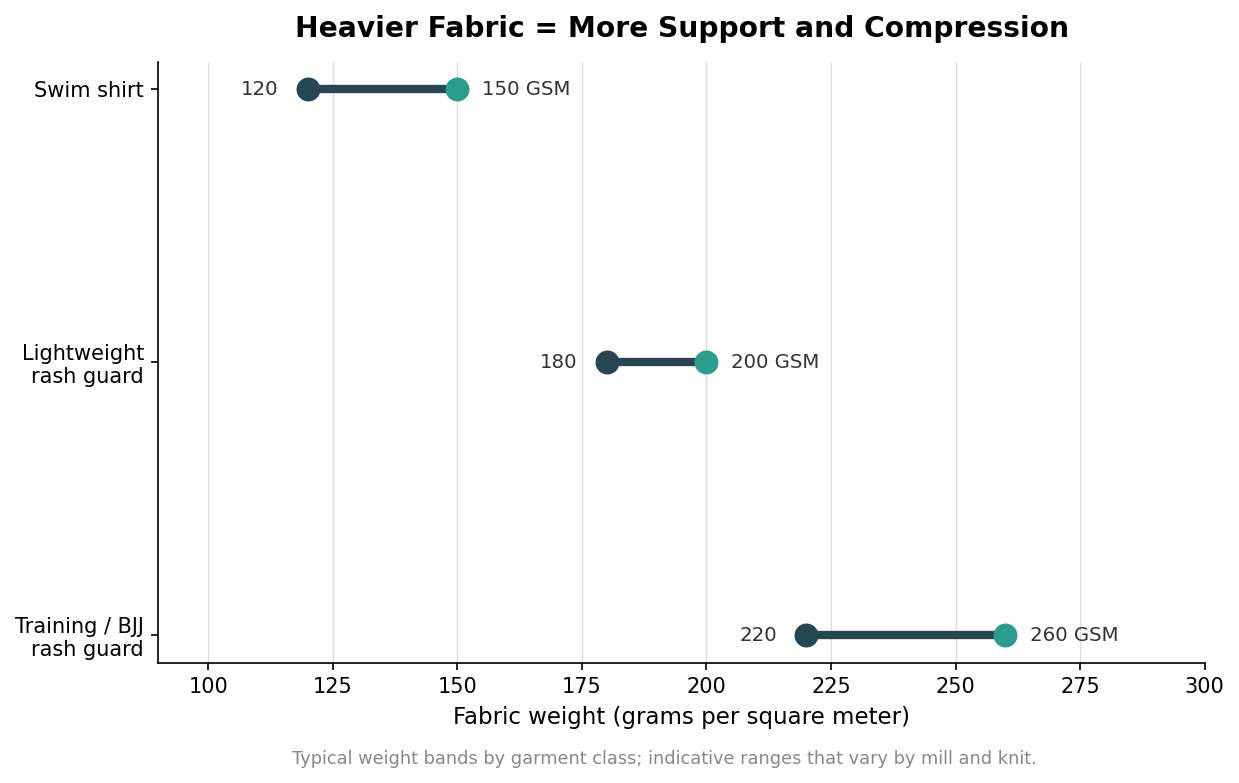
A light 120 to 150 GSM knit feels like a T-shirt and suits casual sun cover, while a medium 180 to 200 GSM fabric gives the supportive, second-skin feel most people associate with a proper rash guard. Heavier 220 GSM and up fabrics, common in grappling and BJJ pieces, add compression and abrasion resistance for skin-on-mat contact at the cost of a little breathability. Heavier is not simply better; it is a trade of support and durability against coolness and packability. Decide what the garment is for, then let the intended use pick the weight band rather than defaulting to the cheapest quote, which is almost always the lightest fabric.
Seams decide whether it chafes
Construction matters as much as cloth on a garment worn against bare skin. A flatlock seam joins two panels edge to edge and stitches them into a single flat plane, so there is no raised ridge to rub. That is why flatlock is the standard on rash guards meant for grappling, surfing, or long wear, where an ordinary raised overlock seam would saw at the skin over hours of movement. Flatlock also lies flatter under a gi and looks cleaner where panels of a sublimated design meet. It is slightly more expensive to produce, and that cost is one of the honest reasons a well-made rash guard is not the cheapest one on the page. When you evaluate a sample, run a finger along the inside seams; if you can feel a ridge, imagine it against your skin during the tenth minute of a hard round.
Weave and weight carry the sun protection
Sun performance is often treated as a coating, but on a good rash guard it is mostly a function of the fabric itself: a tight, higher-weight synthetic knit simply lets less ultraviolet light through. The UPF label puts a number on it, and the number means something specific.
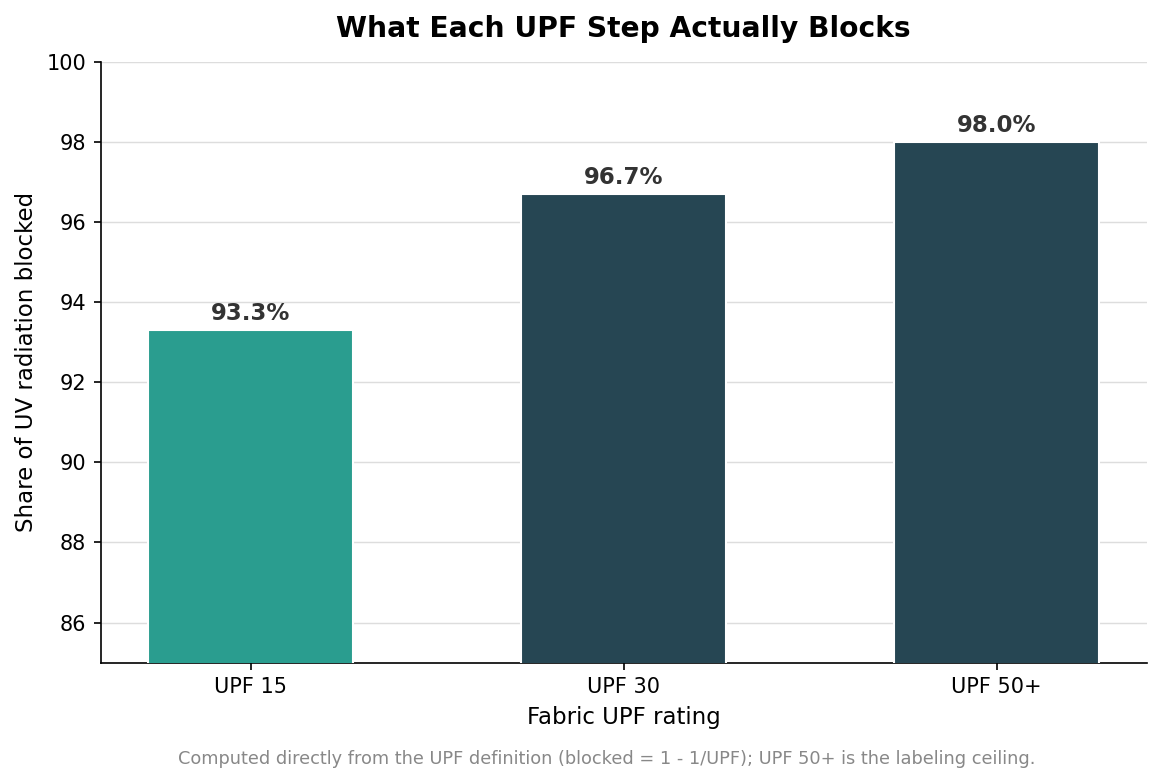
The jump from UPF 15 to UPF 50+ looks small on a percentage axis but represents cutting the UV that reaches skin from about one part in fifteen to one part in fifty. A dense polyester knit in the medium weight band will typically hit UPF 50+ without any special treatment, which is another quiet argument for polyester and for not going too thin. The fabric is the sunscreen here; the rating just reports how well it works.
Read the spec, then the sample
Put together, four numbers tell you most of what you need before a single unit ships: the fiber blend, the spandex percentage, the GSM, and the seam type. A polyester-dominant blend around 82/18, near 15 to 20 percent spandex, in a 180 to 220 GSM knit with flatlock seams describes the sweet spot for a printed, hard-wearing custom rash guard. Get those on the spec sheet, then confirm them against a physical sample by stretching it four ways, checking the recovery, and feeling the seams. The print is the part everyone notices; the fabric is the part everyone remembers after the tenth wear.